2026 BUSINESS CLIMATE SURVEY

The Vermont Futures Project 2026 Business Climate Survey offers an in-depth, data-informed look at how Vermont employers are experiencing the state’s economic landscape. The survey gathered insights from 135 employers across all fourteen counties and a wide range of industry sectors. 

Affordability Pressures Are Reshaping Everyday Business Decisions

The 2026 Vermont Business Climate Survey captures the real-world choices facing employers across the state: whether to hire, invest in new equipment, absorb double-digit healthcare hikes, or expand outside Vermont. This year’s findings reflect an increasingly constrained operating environment where cumulative cost pressures—led by healthcare, workforce shortages, and housing—are compelling businesses to alter operations, delay capital investments, and raise prices.

Key Findings:

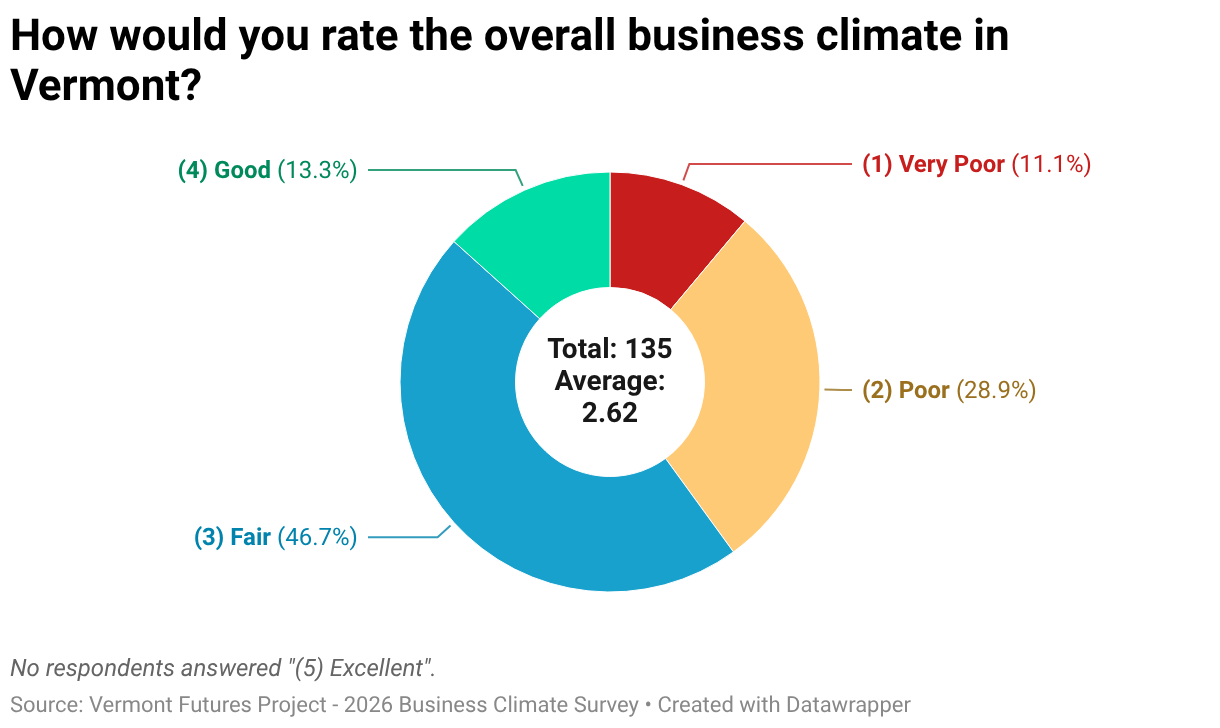
  • 2.62 / 5.00 — Overall Business Climate Rating: Down from 2.86 in 2025, with 40% of employers rating the climate poor or very poor (1 or 2), compared to 29% last year.

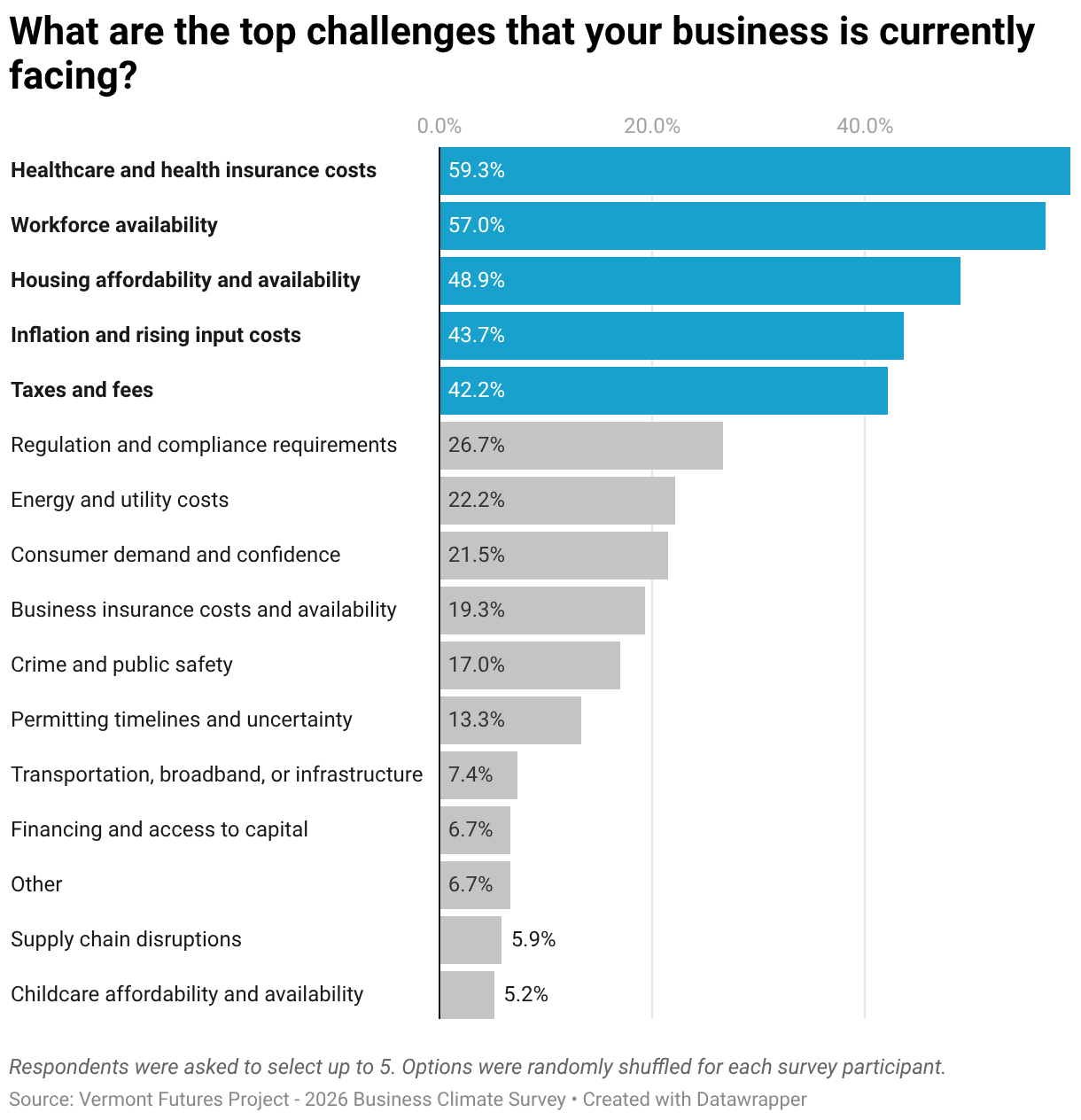
  • 59% — Healthcare Costs as Top Challenge: Healthcare and health insurance surpassed workforce availability to become the most cited obstacle for Vermont employers.

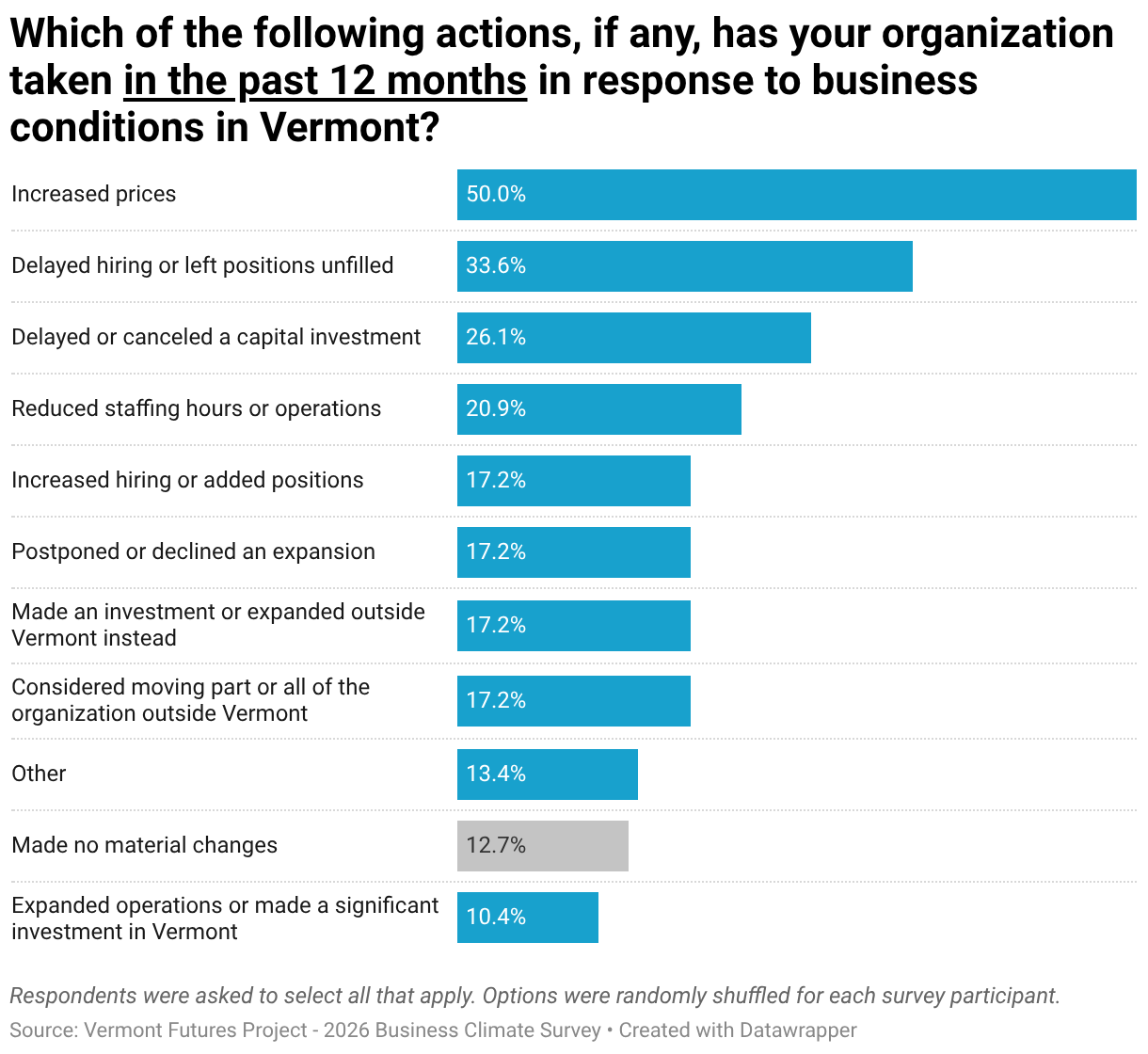
  • 50% — Pushed to Raise Prices: In response to business conditions over the past year, half of participating employers increased prices, one-third delayed hiring, and one-quarter paused or canceled capital investments.

How would you rate the overall business climate in Vermont? (Donut Chart)


What are the top challenges that your business is currently facing? (Bar Chart)


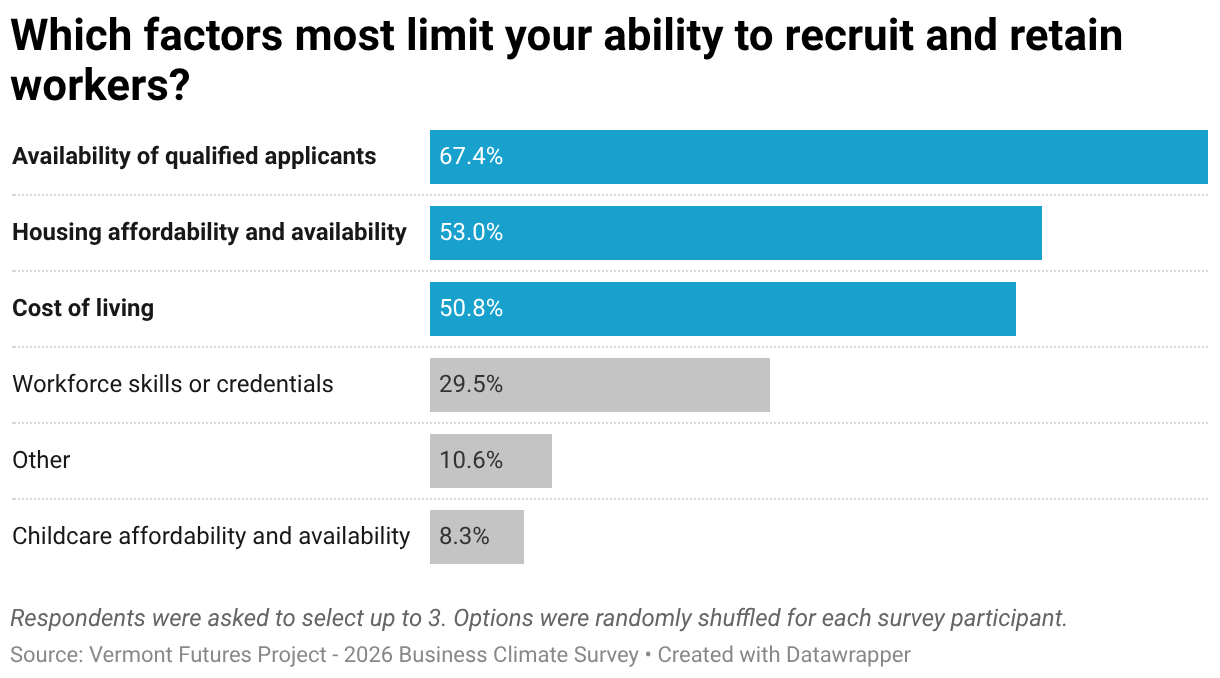
Which factors most limit your ability to recruit and retain workers? (Bar Chart)

Shifting from Growth to Stability as Expansion Plans Pause

Vermont businesses report a clear shift toward stability over expansion. While severe contractions remain contained, the share of employers reporting top-line growth dropped to 37% over the past 12 months (down from 43% in 2025), while 32% experienced declines and 31% remained steady. Looking ahead, expectations point toward continued plateauing: 37% anticipate growth, while 59% expect their headcount to remain flat. Caution is particularly acute in capital deployment. Over the past year, 26% of employers delayed or canceled capital spending, 17% postponed expansions, and 17% chose to invest or expand outside Vermont instead. 

Health insurance is a top challenge and policy priority for businesses.

Healthcare and health insurance have surged to the forefront of Vermont’s affordability crisis. Ranked as the #1 operational hurdle by 59% of employers, healthcare cost containment is also the #1 state policy priority, selected by 54% of respondents. Rising premiums create a compounding burden: they reduce worker take-home pay through payroll deductions while depleting employer resources needed for wage increases, new hires, and facilities.

Among participating employers, 60% offer employer-sponsored coverage. For those providing benefits, premium inflation forces difficult trade-offs: 65% are working to absorb increases to maintain current benefit designs, while 11% plan to increase employee cost-sharing. For the 40% of businesses that do not offer coverage, systemic expense remains the insurmountable barrier.

Uncertainty is impacting business growth and investment.

Vermont businesses draw a sharp distinction between cost and predictability. While 45% describe state taxes and fees as predictable, 68% report that their overall tax burden directly limits organizational operations and growth. On the regulatory side, employers face friction from both cost and procedural uncertainty. Roughly half of respondents describe regulatory requirements and permitting processes as unpredictable. Lengthy approval timelines (32%) and overlapping, conflicting mandates (32%) represent the most significant operational drags, stalling project viability and escalating overhead.

Businesses are using artificial intelligence in pursuit of productivity gains.

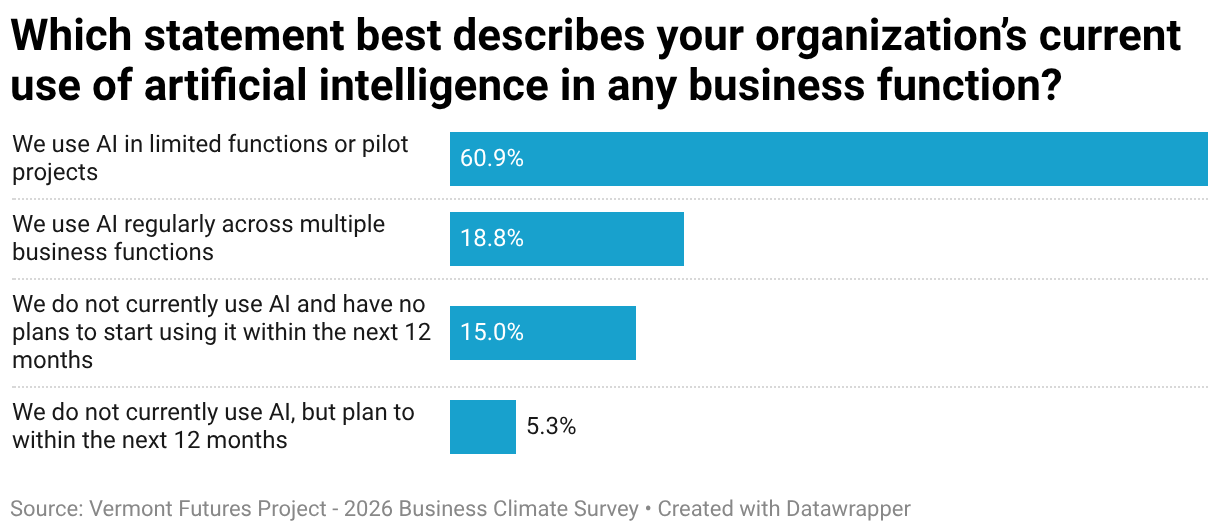
Four out of five (80%) participating employers report actively utilizing artificial intelligence within their operations. While widespread integration across full enterprise workflows remains in early stages (19%), the majority of businesses are deploying AI in targeted functions, internal workflows, and pilot use cases.

Operational efficiency and administrative relief dominate organizational goals. Employers identify productivity gains and the automation of routine documentation as the primary realized or expected outcomes of adoption. However, scaling these tools requires addressing clear friction points: businesses report active needs surrounding data privacy, compliance, cybersecurity, and practical workforce upskilling.

Trade conditions are raising concerns for businesses.

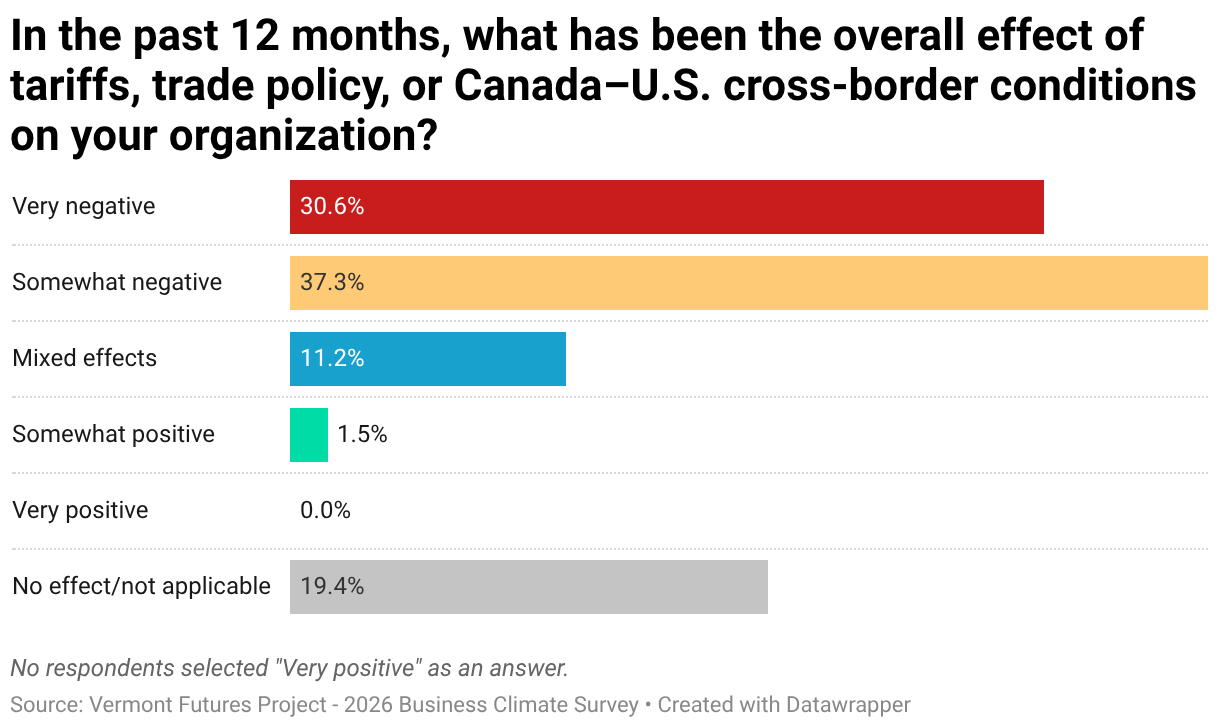
Survey findings indicate that trade conditions are negatively affecting businesses, particularly those engaged in cross-border trade and commerce. Concerns about Canadian customer demand, supply chain disruptions, and the cost and availability of inputs highlight the primary challenges employers are facing.

Perceptions that business voices are not being heard remain.

The survey highlights an enduring disconnect between the business community and state policymakers. A growing majority—56% of participating employers—do not believe the voice of business is heard in Montpelier, up from 53% in 2025, while only 25% feel heard. Furthermore, 71% of business leaders express a lack of confidence that elected officials understand the day-to-day economic realities and cost pressures facing Vermont employers.

Despite this sentiment, business leaders show a high willingness to engage directly in the legislative process. Half (50%) of respondents report feeling comfortable contacting their local legislators to discuss issues impacting their enterprise.

Short-term priorities towards long-term economic goals.

When asked to identify the three state policy outcomes that would most improve their ability to operate, invest, and grow, Vermont employers established a definitive hierarchy led by reducing healthcare and health insurance costs (54%), containing education spending and property tax growth (33%), and increasing housing production (32%). These are immediate priorities that help to achieve the longer-term growth outcomes in the Vermont Economic Action Plan. 

Addressing the compounding cost drivers of commercial health premiums, property taxes, and housing constraints directly targets the cost-of-living pressures tracked on the Vermont Competitiveness Dashboard. When high structural costs outpace household wages, Vermont becomes economically out of reach for the people and families who want to live and work here. Prioritizing these policy areas lowers that barrier, transforming Vermont from merely a desirable destination into an economically viable choice for working families building their futures. 

Accelerating residential development expands the housing stock, removing the primary bottleneck to attracting and retaining the working-age population required to replenish our labor force. In turn, expanding the working-age demographic broadens the state’s tax and economic base, distributing the shared costs of public investments, reinforcing sustainable affordability, and driving stronger, more prosperous outcomes for all Vermonters.